

You sit in the barber chair. The barber asks, “What kind of fade?” You freeze. Burst fade? Drop fade? They sound alike, but they cut very differently.
This guide explains both cuts in plain words. You will see how each one looks on straight, wavy, curly, and coily hair. You will also learn how to ask for the right cut and how to keep it fresh. By the end, you can walk into any shop in the USA and say exactly what you want.
Burst fade vs drop fade: five matched visual comparisons
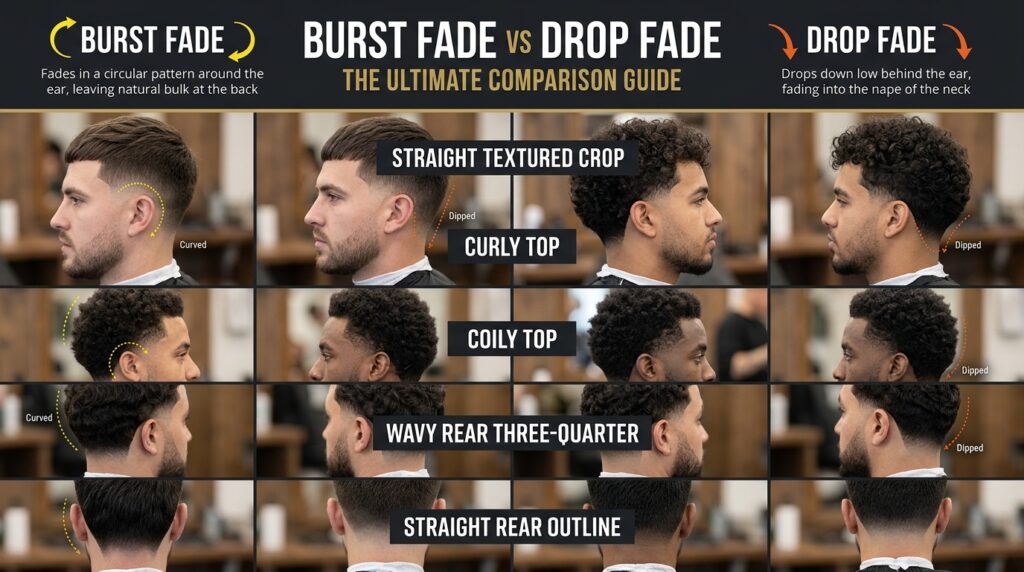
The best way to learn the difference is to picture the same hair type with each fade. Here are five common setups. In each one, the top stays the same and only the fade changes.
Straight textured crop
A textured crop has short, choppy layers on top and a blunt fringe. With a burst fade, the fade wraps around the ear in a half circle. The sides stay longer at the back and the neckline stays full.
With a drop fade, the fade line curves down behind the ear. It dips toward the nape. The cut looks sharper from the side and gives the crop a cleaner, more athletic shape.
Curly top
Curls need room to show off. A burst fade keeps weight at the back of the head. That helps curls look full and balanced, because the fade does not pull the eye down.
A drop fade on a curly top creates a stronger contrast. The curls sit high and the sides fall away fast. This works well if you want a bold, modern look.
Coily top
Coily hair holds a fade line very well. A burst fade on coily hair gives a soft, rounded shape around the ear. The sharp line-up at the front pairs nicely with it.
A drop fade on coily hair looks dramatic. The curved line behind the ear shows up clearly, even from a distance. Many barbers love it for this reason.
Wavy rear three-quarter
Take a look from the back and side at the same time. This is the angle most people miss. A burst fade shows a neat curve around the ear and a thicker back.
A drop fade shows a long arc that slides down toward the neck. Wavy hair on top flows over this arc. The result looks smooth and layered.
Straight rear outline
From directly behind, the shapes differ most. A burst fade keeps a rounded outline. The neckline can be tapered, squared, or left natural.
A drop fade has a lower, curved outline. The line drops behind the ear and often rises again near the center. This makes the head look longer and narrower.
Burst Fade vs Drop Fade: Three Placement References

Where the fade sits matters more than the name. Think of three places in your head. Each one changes how the cut looks.
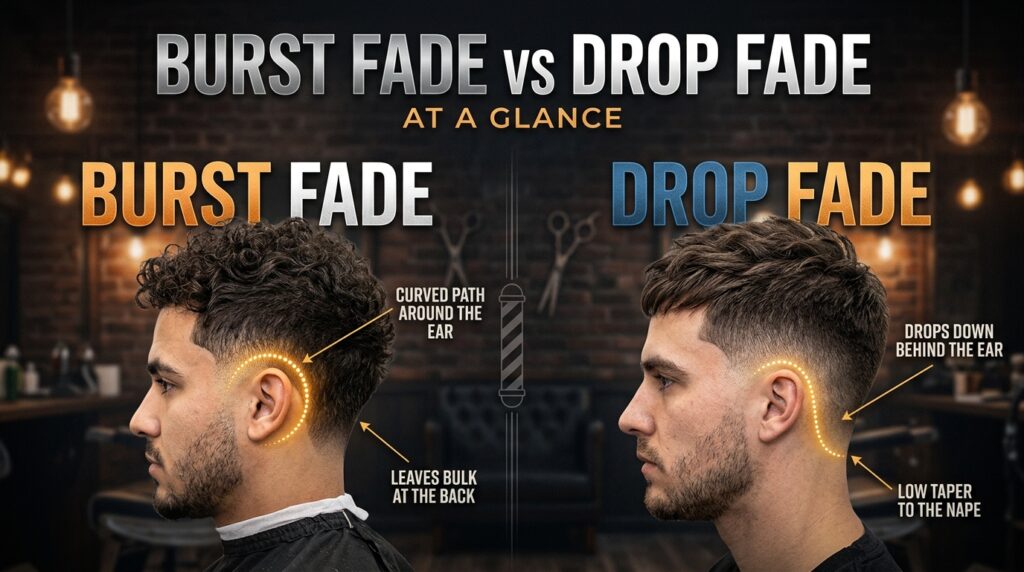
- The ear: A burst fade curves around the ear like a half circle. A drop fade starts above the ear and arcs down behind it.
- The temple: Both fades can start low or high here. A mid burst fade starts near the middle of the sides. A low version starts closer to the ear.
- The nape: A burst fade usually leaves the nape fuller. A drop fade pulls the line down toward the neck.
Use these three points as a map. When you show a photo to your barber, point at them. It saves time and avoids mistakes.
Placement also changes how the fade grows out. A fade that sits higher can look shaggy sooner. A low drop can stay neat longer on the neck but may fuzz up around the ear.
Compare your preferences first
Before you pick a cut, ask yourself a few simple questions. Your answers will point you in the right direction.
- Do you want a rounded, soft look or a sharp, curved line?
- Do you wear glasses or earrings that sit near the ear?
- Do you have a flat spot or cowlick at the back of your head?
- Do you tuck hair behind your ears on top?
- How often can you visit the barber?
If you like soft shapes and a fuller back, lean toward a burst fade. If you like sharp contrast and a longer neck line, lean toward a drop fade.
Also think about your lifestyle. Gym-goers and athletes often like the drop fade. Office workers often like the burst fade because it looks tidy without being too bold.
Many people on Reddit say the same thing. They ask for a burst fade for a clean look and a drop fade for style. Both are good. The right pick depends on you.
Burst Fade vs Drop Fade at a Glance
Here is a quick table. Use it as a cheat sheet.
| Feature | Burst Fade | Drop Fade |
| Shape | Half circle around the ear | Curved line that drops behind the ear |
| Back of head | Fuller, rounder | Longer, sharper |
| Contrast | Soft to medium | Medium to high |
| Best for | Rounded looks, mullets, curls | Clean lines, sleek styles |
| Maintenance | Every 2 to 3 weeks | Every 2 weeks |
| Grow-out | Fuzzy but rounded | Sharp line fades slowly |
| Works with | Most hair types | Most hair types |
The two cuts share the same base idea. Hair gets shorter as it moves down. The difference is the path that the fade line takes.
You can also compare them to other fades. A drop fade vs low fade is a common question. A low fade stays straight and level above the ear. A drop fade curves and falls lower in the back. So a drop fade has more shape.
A burst fade vs taper fade is another popular one. A taper fade only trims the edges. It leaves most of the length. A burst fade removes much more hair around the ear and creates a clear curve.
Read More: Mod Haircuts for Men
What a Burst Fade Actually Does
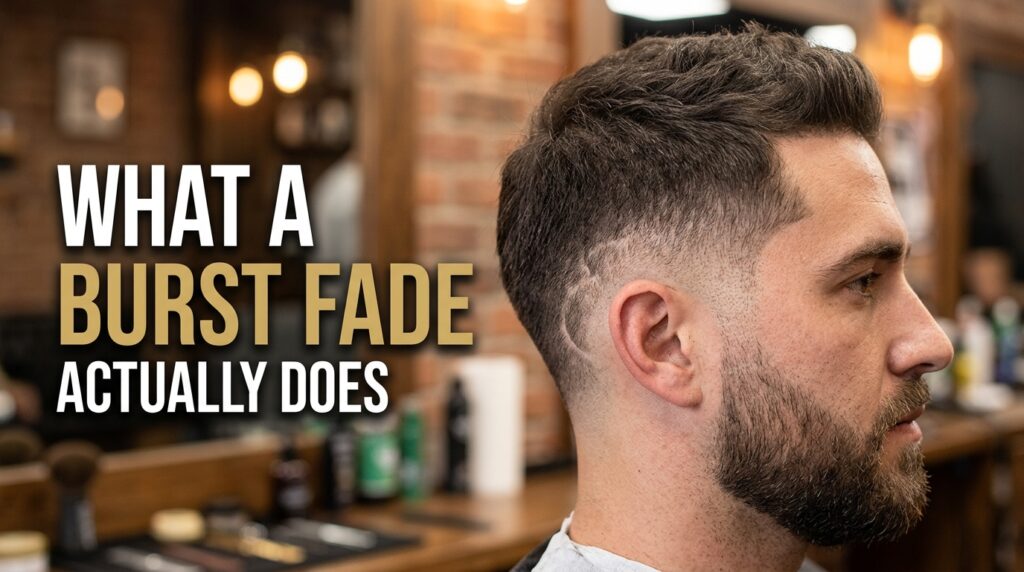
A burst fade is built around the ear. The barber starts a fade above the ear and curves it around the ear like a ripple. The hair gets shorter close to the ear and stays longer at the back.
This shape leaves a “fan” of hair behind the ear. That is why you often see it with mullets and longer back styles. The burst fade frames the head and keeps weight in the back.
The cut can use different guards. Some barbers go down to the skin. Others stop at a short stubble. The choice changes how bold the cut looks.
Here is what a burst fade does well:
- It adds shape without making the sides too short.
- It keeps the back full.
- It blends well with longer tops, curls, and waves.
- It gives a soft finish near the ears.
A burst fade mullet is a popular combo. The top stays textured, the sides get the burst, and the back keeps length. It looks bold but still neat. If you want a modern mullet, this is a smart base.
A mid burst fade starts higher on the head. It leaves less hair on the sides and shows more of the curve. A low burst fade stays closer to the ear and looks softer. Both work. The mid version has more drama.
What a Drop Fade Actually Does
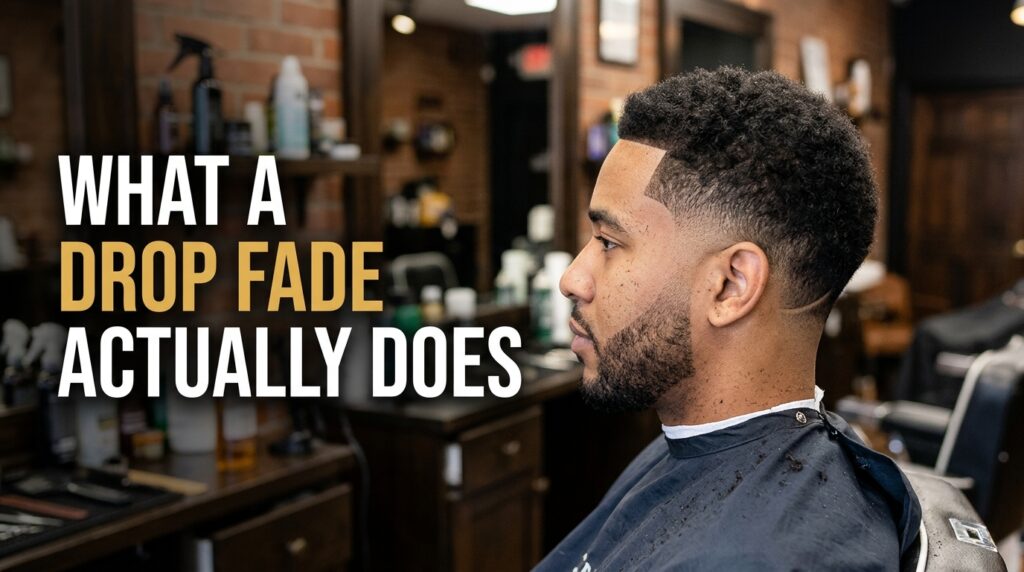
A drop fade follows the shape of your head. The fade line starts at the front near the temple. It then curves down behind the ear and “drops” toward the nape.
Think of it like a smile line that tilts. The line is higher in the front and lower at the back. This creates a clean, flowing shape.
Barbers love this fade because it fits almost every head shape. It can make a round head look longer. It can also add shape to a flat back of the head.
A drop fade can be low, mid, or high. A low drop fade keeps the fade near the neck. A high drop fade starts higher and shows more skin. Most men in the USA choose a low or mid drop for daily wear.
Here is what a drop fade does well:
- It gives a sharp, curved outline.
- It works with short crops, quiffs, and fringes.
- It shows off a clean neckline.
- It looks great from the side and back.
On Black hair, a drop fade is a favorite. The line stays crisp on tight curls and waves. Many barbers pair it with a sharp edge-up and a defined shape on top. If you search for a burst fade vs drop fade Black style, you will see both. The drop fade often looks cleaner. The burst fade often looks fuller.
On straight hair, a drop fade makes the top look more textured. Straight hair can look flat, so the contrast adds depth. A burst fade vs drop fade for straight hair often comes down to taste. The burst looks softer. The drop looks sharper.
The Ear and Nape Test
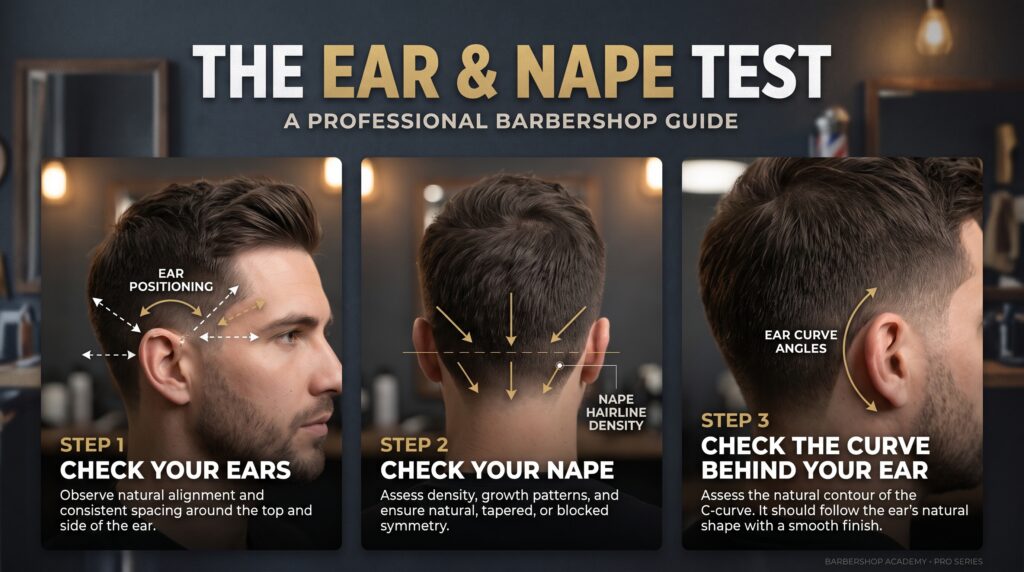
Two small spots decide which fade suits you best. They are the ear and the nape. Try this simple test at home with a mirror.
Step 1: Check your ears. Do your ears stick out? If yes, a burst fade can draw attention to them. A drop fade tends to hide them more. If your ears sit close to your head, both cuts work.
Step 2: Check your nape. Look at the back of your neck. Is the hairline low and thick? Or is it high and thin? A thick low nape can handle a drop fade. A thin nape may look better with a burst fade that leaves more hair.
Step 3: Check the curve behind your ear. A flat or sharp curve may suit a drop fade. A round shape may suit a burst fade.
Here is a simple guide:
| What you notice | Better choice |
| Ears stick out | Drop fade |
| Thin hair at the nape | Burst fade |
| Thick, low neckline | Drop fade |
| Round head shape | Drop fade |
| Flat back of the head | Burst fade |
| Hair whorl near the crown | Burst fade |
This test is not a strict rule. It is a helpful start. A good barber will look at your head and adjust the cut.
Take a photo of the back of your head too. It helps you see what the barber sees. Share it when you explain what you want.
Choose the Finish Separately
The fade is only one part of the haircut. The finish is the other part. You can choose a finish no matter which fade you like.
The finish means three things:
- How short the fade goes: skin, shadow, or short stubble.
- How the neckline looks: tapered, blocked, or rounded.
- How the edges look: natural, soft, or sharp.
A skin fade goes all the way down to the skin. It looks crisp and bold. A shadow fade stops just short of skin. It looks softer and hides regrowth better.
A tapered neckline blends into the neck. It grows out gently. A blocked neckline cuts straight across. It looks sharp but grows out faster. A rounded neckline sits in the middle.
Pick the finish based on your style and your schedule. If you only visit the barber once a month, choose a shadow fade and a tapered neck. If you love a sharp look, choose a skin fade and a blocked neck.
Remember that you can mix and match. A burst fade with a skin finish looks very clean. A drop fade with a shadow finish looks soft and modern.
Do not forget your line-up. A crisp line-up at the forehead and temples makes any fade look better. It also helps the cut look fresh longer.
Which One Should You Choose?
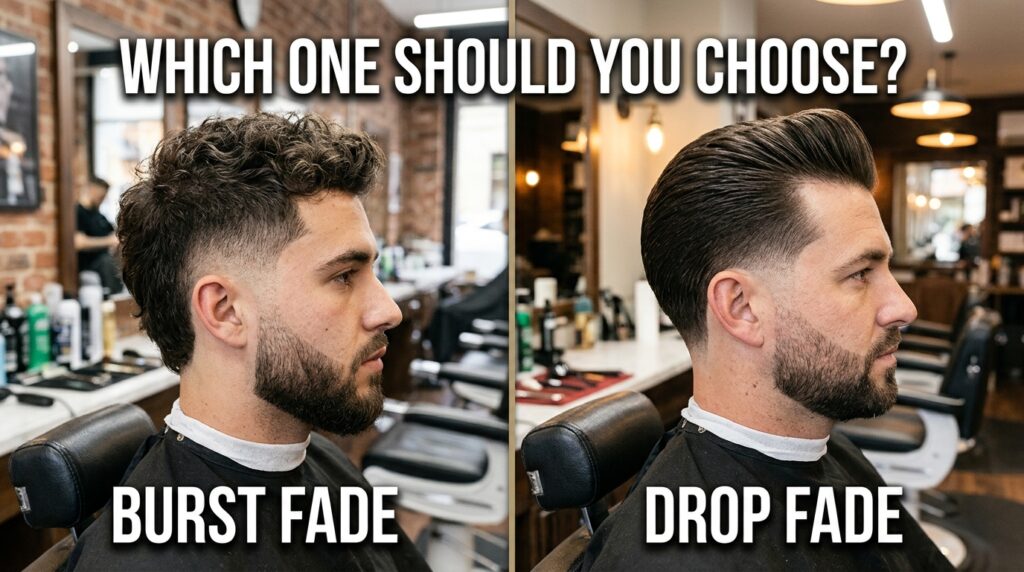
Still unsure? Use this section to decide. Both cuts look good. The right one is the one that fits your face, hair, and habits.
Ask a few more questions:
- What hair texture do you have?
- How long is the hair on top?
- Do you want a safe look or a bold one?
- How much time do you have to style it?
If you want a quick answer, pick the burst fade for a fuller back and the drop fade for a sharper shape. That is the simplest way to remember the difference.
Choose a burst fade if…
- You like a rounded, soft shape around the ear.
- You want to keep length at the back.
- You plan to grow a mullet or longer back.
- You have curls and want them to look full.
- You prefer a cut that grows out in a rounded way.
- You want a bold but friendly style.
A burst fade also suits men who want a change without going too short. It adds style without hiding the hair on top.
Choose a drop fade if…
- You like a sharp, curved outline.
- You want a longer, cleaner neck line.
- You have a round head and want more shape.
- You want a polished look for work or events.
- You like short crops, quiffs, or textured tops.
- You are fine with a trip to the barber every two weeks.
A drop fade also suits men who want a modern look that is easy to style. It needs less product because the shape does most of the work.
Drop Burst Fade: Can You Combine Them?
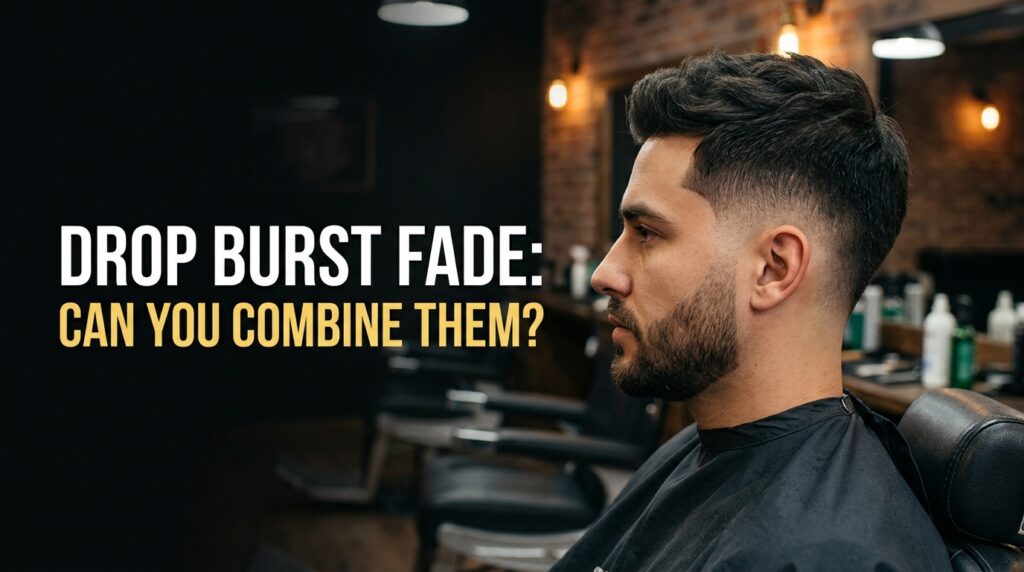
Yes, you can. A drop burst fade mixes both shapes. It uses the curved drop line and the circular burst around the ear. The result is a bold, layered fade with lots of depth.
Here is how it works. The barber starts with the burst fade around the ear. Then the barber drops the fade line lower behind the head. The back keeps some length, and the sides get a sharp curve.
Some people search for a burst drop fade or a drop burst fade. They all mean the same hybrid. The name changes, but the cut stays the same.
This blend suits people who like both looks. It gives you the soft fullness of the burst and the sharp lines of the drop. It also works nicely with mullets, curls, and waves.
Keep in mind that the hybrid is harder to cut. Not every barber has done it often. Show a photo and explain the shape. A skilled barber will understand fast.
Here is a quick look at the pros and cons:
| Pros | Cons |
| Unique, modern look | Needs a skilled barber |
| Good shape from every angle | Needs regular upkeep |
| Works with many hair types | Can look busy on short tops |
If you want a safe start, try a burst or drop fade first. Then add the hybrid once you know what you like.
How to Ask Your Barber
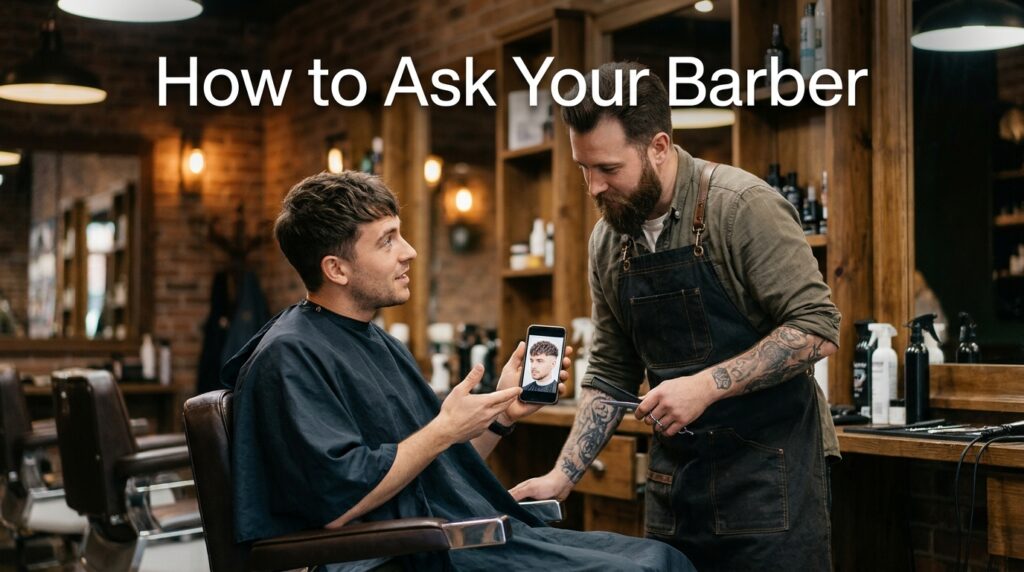
Clear words save you from a bad cut. A good barber wants to help, but they need clear details. Here is a simple way to ask.
Bring photos. Show pictures from the front, side, and back. Pictures say more than words.
Name the fade type. Say “burst fade” or “drop fade.” If you want the hybrid, say “drop burst fade” and show a photo.
Say how high or low. Use words like “low,” “mid,” or “high.” You can also point at your head.
Say how short. Ask for “skin,” “shadow,” or a guard number. Most barbers know what that means.
Talk about the neckline. Say if you want it tapered, rounded, or blocked.
Mention the top. Tell the barber how much to leave. Say “keep length on top” or “take off an inch.”
Here is a sample script you can use:
“I’d like a mid drop fade with a skin finish. Keep the top about three inches with texture. Please taper the neckline and give me a clean line-up.”
Or for a burst fade:
“I want a low burst fade with a shadow finish. Leave the back long for a mullet. Keep the sides soft and blended.”
Use these as a template. Change the words to match your style.
Also, speak up early. If the barber starts a cut you do not like, say so right away. It is easier to fix a small problem than a big one.
Maintenance and Grow-Out
Fades look best when they are fresh. Within a week or two, the line starts to blur. Here is what to expect.
| Fade | Best touch-up time | Grow-out feel |
| Low burst fade | Every 3 weeks | Soft and rounded |
| Mid burst fade | Every 2 to 3 weeks | Fuzzy around the ear |
| Low drop fade | Every 2 to 3 weeks | Clean for longer |
| Mid or high drop fade | Every 2 weeks | Line loses shape fast |
| Drop burst fade | Every 2 weeks | Needs a skilled blend |
Use these tips to keep your fade neat:
- Wash your hair two or three times a week.
- Use a light moisturizer on the scalp and sides.
- Use a soft brush to shape curls or waves.
- Sleep on a satin pillowcase or wear a durag.
- Use a trimmer to clean the neckline between visits.
- Do not cut the fade yourself. Small mistakes show up fast.
If you want a longer grow-out, ask for a shadow fade and a tapered neckline. They hide regrowth better. A skin fade needs more frequent visits.
When you want to grow out the fade fully, let the hair rest for six to eight weeks. Then ask your barber to blend the sides into the top. You can also switch to a taper for a few months. This makes the change smoother.
Finally, be kind to your scalp. Fades can show dry skin, bumps, or razor irritation. Use a gentle aftershave or a soothing balm. If irritation lasts, talk to your barber or a doctor.
Frequently Asked Questions
What is the main difference between a burst fade and a drop fade?
A burst fade curves around the ear in a half circle and keeps the back fuller. A drop fade curves down behind the ear and gives a sharper, lower line.
Is a drop fade or a burst fade better for curly hair?
Both work well. A burst fade keeps curls full at the back. A drop fade adds sharp contrast and a cleaner shape.
Can I get a drop burst fade?
Yes. A drop burst fade blends both shapes into one cut. Bring a photo and choose a barber with fade experience.
How often should I get a burst fade or drop fade?
Most people need a touch-up every two to three weeks. Skin fades and high drop fades may need a visit every two weeks.
Is a burst fade good for a mullet?
Yes. A burst fade keeps the back long while the sides stay neat. That makes it a popular base for a modern mullet.
Final Thoughts
Burst fades and drop fades both give you a clean, modern look. The burst fade curves around the ear and keeps the back full. The drop fade drops behind the ear and gives a sharper, longer shape.
Pick the one that matches your hair, head shape, and routine. Try the ear and nape test, bring photos, and speak clearly with your barber. If you love both, ask for a drop burst fade and enjoy the best of each. A great fade starts with a simple conversation.

Adam Collins is a fashion writer and content researcher at Faxhion Serp. He focuses on fashion trends, clothing, styling ideas, accessories, and practical wardrobe guidance. Adam creates clear, well researched articles designed to help readers understand fashion topics, discover fresh ideas, and make informed style choices.