
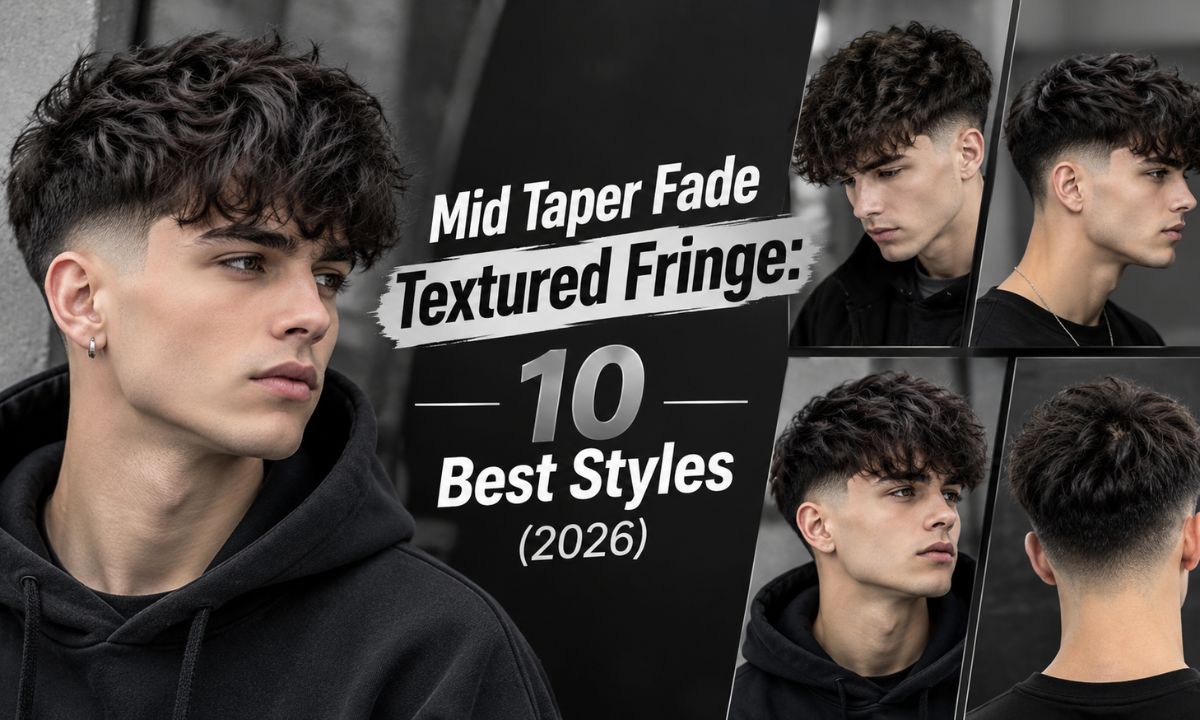
The mid taper fade with a textured fringe is one of the most popular men’s cuts in the United States right now. It looks sharp. It looks relaxed. It works in an office, at a gym, and on a Saturday night.
The cut has two parts. The sides and back are short and clean. The top is longer, with a soft, broken-up fringe that falls onto the forehead. The mix of neat and messy is what makes it so easy to like.
In this guide, you will learn what the cut really is, how to ask for it, and how to style it. You will also see 10 of the best versions for different hair types, from curly to straight to thick. Let’s start.
Textured Fringe and Mid Taper: Three Useful Views

Before you book a haircut, it helps to see this style from three angles. Each one answers a different question.
View 1: The shape. The cut is built in contrast. The sides are tight. The top is longer and has movement. This contrast makes your face look sharper and your hair look fuller.
View 2: The upkeep. The taper is low drama. It grows out softly. The fringe is forgiving too, because texture hides small mistakes. Most men need a trim every three to five weeks.
View 3: The fit. The style suits many face shapes, hair types, and jobs. You can keep it clean for work or push it messy for the weekend. That range is a big reason it keeps trending.
Here is a quick snapshot of what you get with this cut.
| Feature | What to Expect |
| Sides and back | Short, tapered, and neat |
| Top | Longer, layered, and textured |
| Fringe | Forward, short to medium length |
| Upkeep | Trim every 3 to 5 weeks |
| Styling time | 3 to 5 minutes |
| Best for | Most face shapes and most hair types |
Think of the cut as a simple recipe. A clean base, a loose top, and a little product. That is all it takes.
What “Textured Fringe” Actually Means

A fringe is hair that falls forward over the forehead. Some people call it bangs. Men’s barbers usually say fringe.
A textured fringe is a fringe with layers and broken edges. The ends are not cut in one flat line. Instead, the barber cuts into the hair with scissors, a razor, or thinning shears. This makes the ends look light and uneven in a good way.
The result has a few clear traits:
- The fringe has movement and does not sit flat.
- The ends look soft, not blunt.
- The hair holds a shape with a little product.
- It looks natural, as if you just woke up with great hair.
Texture is also about how the hair feels. Good texture gives your hair grip. It lets you style it with your fingers and keep it in place all day.
A textured fringe is not the same as a heavy, straight-across fringe. That older look can feel stiff. The textured version feels modern and easy.
Below are the 10 best ways to wear this cut. Each one fits a different hair type, length, or look.
Here are the 10 best styles, numbered from 1 to 10. After them, you will find 10 bonus styles for special hair types and looks.
1. Mid Fade Fringe
The mid fade fringe is the classic starting point. The fade begins around the middle of the sides, near the temple. Below that point, the hair gets shorter and blends into the skin or a very short guard.
The top keeps its length. The fringe is cut with soft layers and combed forward. It can sit straight across or slightly to one side.
This look is great if you want a clear, clean line. A mid fade is bolder than a taper. It draws the eye to the contrast between the sides and the top.
Best for: Men who like a sharp, modern look and don’t mind more frequent trims.
Quick tip: Ask your barber to blend the fade high enough to show shape, but low enough to stay work friendly.
2. Mid Taper Fade Textured Fringe Curly Hair
Curly hair and a textured fringe go together well. Curls already have natural texture. The barber only needs to shape them and keep them under control.
On curly hair, the top is usually left longer, around three to four inches. The curls fall forward into a loose, bouncy fringe. The taper keeps the sides neat so the curls look intentional.
The key is to avoid cutting curly hair too short on top when it is dry. Curls spring up once cut. A good barber will cut with that spring in mind.
Best for: Type 2 and Type 3 curls, from loose waves to tight ringlets.
Quick tip: Use a curl cream on damp hair and let it air dry or use a diffuser. Skip heavy gel, which can make curls crunchy.
Read More: Modern Mullet Fringe
3. Mid Taper Fringe
The mid taper fringe is the softer cousin of the mid fade. A taper does not drop to the skin. It only shortens the hair gradually around the ears and neckline.
This makes the cut look more natural and less edgy. It is a safe pick if you wear a suit to work or want something that grows out well.
The fringe stays textured and slightly longer in front. You can brush it forward or push it up and to the side.
Best for: Professionals, students, and anyone who wants a low-risk cut.
Quick tip: Ask for a “mid taper” and say you do not want skin showing. That tells your barber to keep it soft.
4. Mid Taper Fade Textured Fringe Straight Hair
Straight hair can look flat. A textured fringe fixes that. The barber adds layers so the hair stops lying in one heavy sheet.
With straight hair, the fringe often sits a little heavier on the forehead. To keep it light, the barber point cuts the ends and thins the bulk. This gives you that broken, messy finish.
Straight hair also shows every line. That means the taper needs to be clean. A crisp blend on the sides looks great against smooth, straight strands.
Best for: Men with fine to medium straight hair who want more movement.
Quick tip: Use sea salt spray before blow drying. It adds grit and lift that straight hair often lacks.
5. Mid Taper Fade with Textured Top
This version focuses on the top more than the fringe itself. The hair on top is cut into layers and styled up and back, or up and forward, with a messy finish.
The fringe still shows, but it sits higher on the forehead. It is a good middle ground if you want volume without hair in your eyes.
The taper keeps the sides neat so the volume on top looks controlled. It is a favorite for men who play sports or work with their hands.
Best for: Men who want height and body on top.
Quick tip: Blow dry your hair upward with a round brush, then finish with a matte paste.
6. Mid Taper Fade Textured Fringe Asian
Many Asian men have thick, straight, strong hair. This hair type holds a textured fringe very well. It also tends to grow outward, so shaping matters.
The barber often uses thinning shears to remove weight. Without that step, thick straight hair can look like a helmet. With it, the fringe falls in soft, separated pieces.
The mid taper keeps the sides slim. This stops the head from looking wide and makes the top stand out. Many men choose a slightly longer fringe that brushes the eyebrows.
Best for: Men with thick, straight, dark hair.
Quick tip: Use a lightweight clay and blow dry the fringe forward first. This trains the hair to fall the right way.
7. Fringe Mid Taper Fade
This one puts the fringe first. The fringe is the star, and the taper plays a supporting role. It is cut a bit longer and lower on the forehead.
It suits men who like an edgy, youthful look. It pairs well with a casual wardrobe, such as hoodies, denim, and sneakers.
The taper keeps the cut from looking messy. Without it, a long fringe can feel unfinished. With it, the whole shape looks planned.
Best for: Men with oval, oblong, or longer face shapes. A fringe adds width to the forehead area.
Quick tip: Keep the fringe short enough that you can see clearly. If it hits your eyes, trim it.
8. Mid Taper Fade Textured Fringe Low
In this style, the taper starts lower, near the ear and neckline. It is subtle. Most of the sides keep some length, and only the edges get cleaned up.
This is a great choice if you want a softer look. It keeps more hair around the temples. That helps balance a wider face or a stronger jaw.
The fringe is the same textured style, brushed forward or slightly sideways. The overall shape feels relaxed and easy to keep up.
Best for: Men who want a clean look without a bold fade line.
Quick tip: If you are new to tapers, start with the low version. You can always go higher next visit.
9. Mid Taper with Textured Fringe Short Hair
Not everyone wants a long fringe. This version keeps the top short, about one to two inches. The fringe is cropped but still textured.
It is quick to style. A bit of paste and a few finger pulls is all you need. It works well for men with busy mornings or active jobs.
The short length also suits men with thinning hair at the temples. A short, textured fringe can look fuller and hide a receding line.
Best for: Men who want low effort, or those with a hairline that is starting to move back.
Quick tip: Use a matte product. Shiny products show scalp through short hair.
10. Mid Taper Fade Textured Fringe Wavy Hair
Wavy hair has a natural S shape. It sits between straight and curly. This is one of the easiest hair types for a textured fringe.
The waves create built-in layers. The barber just trims them so the fringe falls in a neat, loose pattern. A medium length of two to three inches usually looks best.
The mid taper keeps the sides slim so the waves do not puff outward. The result looks soft, natural, and full of body.
Best for: Men with Type 1C to Type 2C hair who want a low-fuss cut.
Quick tip: Scrunch a little sea salt spray or light cream into damp hair. Let it dry naturally for the best wave pattern.
Bonus 1. Mid Taper Fade Textured Fringe Black Hair

Black men with coily or tightly curled hair can wear this cut very well. The curls give natural volume and texture. The barber shapes the top into a soft, rounded fringe and keeps the sides tidy with a mid taper.
Moisture matters here. Coily hair dries out fast, and dry hair looks dull and breaks easily. A sharp lineup at the front adds a clean frame to the fringe.
Best for: Type 3C to Type 4C hair.
Quick tip: Use a leave-in conditioner and a light oil. Brush or pick the top gently to lift the curls forward.
Bonus 2. Mid Taper Fade Textured Fringe Side Swept
A side swept fringe sits across the forehead at an angle. It starts from a part and flows to one side. This look feels polished but still relaxed.
The barber cuts the fringe longer on one side and layers it so it does not look flat. The mid taper keeps the sides slim, which makes the sweep stand out.
It is a good pick for men who want a little more style at work or at events.
Best for: Round and square faces, since the angle adds length and softens edges.
Quick tip: Part your hair while it is damp, then blow dry in the direction you want it to fall.
Bonus 3. Mid Taper Fade Textured Fringe Thinning Hair
Thinning hair does not mean you have to give up on a fringe. A short, textured fringe can make hair look fuller. The texture breaks up the line of the hairline, so a receding area is less obvious.
Keep the top short to medium. Long hair on thin areas can look stringy. A mid taper helps because short sides make the top look thicker by comparison.
Best for: Men with a receding hairline or thin crown.
Quick tip: Use a matte powder or a light clay. Skip shiny products, because they show the scalp.
Bonus 4. Mid Taper Fade Textured Fringe Long Top
Some men want a lot of hair on top. This version keeps four to six inches up front and lets it move freely. The fringe falls over the forehead and can be pushed back or to the side.
The mid taper is what keeps this long style looking neat. Without it, the cut can look overgrown. With it, the length looks planned.
This style needs more time and more trims on the top, so be ready for a bit of daily care.
Best for: Thick or wavy hair and men who like a flowing look.
Quick tip: Ask for layers inside the length. They stop the top from looking heavy.
Bonus 5. Mid Taper Fade Textured Fringe Blonde
Blonde or bleached hair stands out under a textured fringe. The layers catch the light, and the contrast with a tapered side looks bold.
Bleached hair is drier and weaker than natural hair. Keep the fringe at a medium length and trim often to remove split ends. A taper in a natural shade at the sides can make the blonde top pop even more.
Best for: Men who want a fashion-forward, eye-catching look.
Quick tip: Use purple shampoo once a week to keep brassy tones away, and a deep conditioner to protect the hair.
Bonus 6. Mid Taper Fade Textured Fringe for Teens
Teenagers love this cut because it is cool and easy. It looks modern, and it works for school and sports. The fringe can be worn forward or pushed up for a quick change.
For school dress codes, ask for a taper instead of a skin fade. It looks cleaner and is less likely to cause problems. Keep the fringe above the eyes.
Best for: Teens and young adults who want a trendy but simple cut.
Quick tip: A small amount of paste is enough. Teens often use too much product.
Bonus 7. Mid Taper Fade Textured Fringe with Beard
A beard and a textured fringe make a strong pair. The key is to blend the beard into the taper. The sideburns should flow into the beard without a harsh break.
This gives your whole head one clean shape. The fringe adds youth. The beard adds weight. Together, they balance the face well.
Keep the beard neat. A sharp neckline and trimmed cheek line keep the look polished.
Best for: Men with oval or round faces who want a more rugged feel.
Quick tip: Ask your barber to taper the beard and the hair in the same visit so both match.
Bonus 8. Mid Taper Fade Textured Fringe Slick Back
You can style a textured fringe backward too. This gives a sleek, grown-up look that suits formal events. The texture keeps it from looking too stiff.
Use a bit of pomade or a medium-hold paste. Comb the hair back with your fingers, not a fine comb. A few loose strands at the front keep the look soft.
The mid taper adds a clean finish to the sides. It works well with a suit.
Best for: Weddings, interviews, and office days.
Quick tip: Blow dry the hair back first, then add product for a smoother finish.
Bonus 9. Mid Taper Fade Textured Fringe Fine Hair
Fine hair has thin strands that can look flat. The goal here is to add body. A short to medium fringe with light layers works best.
Avoid cutting too many layers. Too many can make fine hair look thin and wispy. A blunt base with soft texture on the ends gives the best result.
A mid taper helps by making the top look thicker next to the short sides.
Best for: Men with thin, soft, or light hair.
Quick tip: Use a volumizing mousse or sea salt spray before blow drying for lift.
Bonus 10. Mid Taper Fade Textured Fringe French Crop
The French crop is a short, forward-brushed cut with a textured top. The fringe is cropped straight across but broken up with point cutting. It sits high on the forehead.
This is one of the easiest styles to keep. It needs very little product and dries fast. The mid taper gives it a crisp, modern shape.
It suits men who want a neat look with almost no effort.
Best for: Men with straight or wavy hair and a busy schedule.
Quick tip: Ask for the front to be cut with scissors, not clippers, so the fringe stays soft.
Compare your preferences first
Do not walk into a barbershop without a plan. A few minutes of thought will save you from a cut you regret.
Start by asking yourself these questions:
- How much time do I want to spend styling each day?
- Does my job have a dress code?
- How often am I willing to visit the barber?
- Do I want a bold look or a quiet one?
- What is my hair type: straight, wavy, curly, or thick?
Your answers will point you toward the right version. Use this table as a simple guide.
| Your Priority | Best Choice |
| Lowest effort | Mid taper with short textured fringe |
| Soft, safe look | Low taper or mid taper fringe |
| Bold, sharp look | Mid fade fringe |
| Maximum volume | Mid taper fade with textured top |
| Curly or wavy hair | Longer top with a mid taper |
| Thick straight hair | Thinned fringe with a slim taper |
Face shape matters too. Here is a short guide.
- Round face: Add height on top and keep the sides tight. A mid fade works well.
- Square face: A softer taper and a textured fringe soften strong angles.
- Oval face: You can wear almost anything. Try a longer fringe.
- Long face: Keep the fringe forward and low to shorten the look of the face.
- Heart face: A side-swept fringe balances a wider forehead.
Bring two or three photos to your appointment. Photos beat words every time. Pick pictures of men with a similar hair type to yours. That gives your barber a real target.
Textured Fringe vs Messy Fringe

People often mix up these two terms. They look alike, but they are not the same.
A textured fringe is planned. The barber cuts it with a purpose. The layers are placed on purpose, and the ends are broken up on purpose. It looks messy, but it is controlled.
A messy fringe is looser. It may be longer, less shaped, and more random. It relies more on styling than on cutting. Some messy fringes are simply hair that has not been cut well.
Here is how they compare.
| Feature | Textured Fringe | Messy Fringe |
| Cut | Layered and shaped | Often uneven or lightly cut |
| Look | Soft and tidy-messy | Loose and unruly |
| Styling | Easy, holds shape | Needs more effort |
| Upkeep | Regular trims | Trims can wait longer |
| Best for | Work and daily life | Casual, creative looks |
Which one should you pick? If you want a cut that looks good even on a lazy morning, go with textured. The shape is in the cut, so you do not have to fight it.
If you like a rough, grunge feel, a messy fringe may suit you. But be ready to spend more time on styling. And be ready for some bad hair days.
Many barbers blend both ideas. They cut a textured fringe, then you style it messy. This gives you the best of both worlds.
Why Pair It with a Mid Taper?
A fringe needs a strong partner. The mid taper is one of the best.
Here is why it works so well.
- It adds balance. A long top can look heavy. Short, clean sides keep the shape in check.
- It frames the face. Tight sides show your cheekbones and jawline. The fringe softens the forehead.
- It stays neat. A taper keeps the neckline and ears tidy, even as the top grows.
- It grows out well. Unlike a high skin fade, a mid taper does not look rough after a few weeks.
- It suits many settings. You can wear it to the office, a wedding, or the gym.
The taper also gives you flexibility. You can slick the fringe back for a formal event. You can push it forward for a casual day. The sides stay clean either way.
There is a practical benefit too. Short sides feel cooler in summer. They also dry fast after a shower. For men in hot states like Texas, Florida, and Arizona, that is a real plus.
In short, the taper handles the tidy part. The fringe handles the personality. Together, they cover everything.
Mid Taper or Mid Fade Under a Textured Fringe?
This is the most common question barbers hear. The two words sound alike, but the results are different.
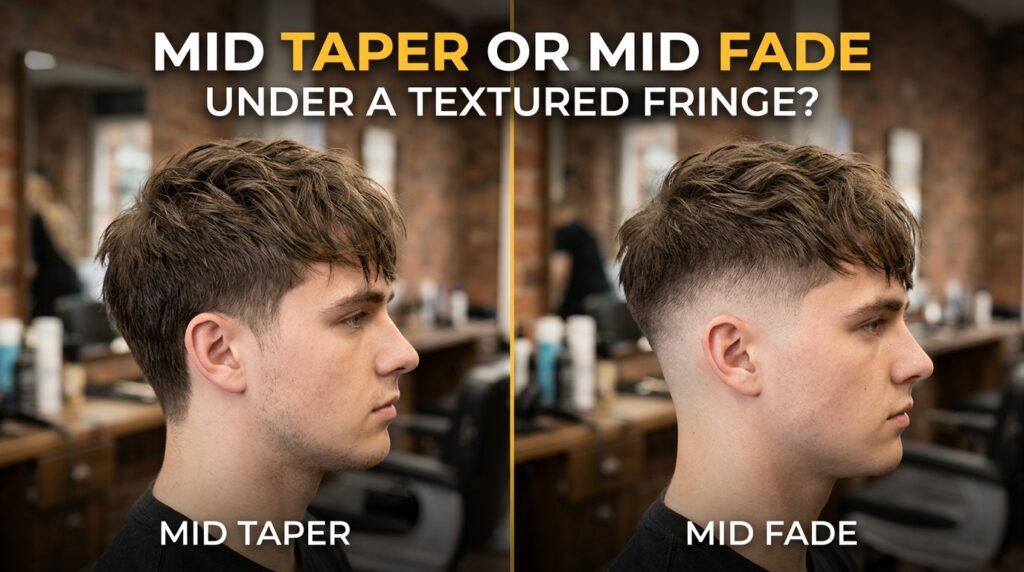
A taper shortens the hair slowly. It usually stops at a short length, like a number 2 or 3 guard. You still see hair on the sides, just shorter.
A fade goes further. It blends all the way down to the skin or a very close shave. You see a clear gradient from long to bare.
Both can start at a mid height. That is why people mix them up. Here is a clean comparison.
| Feature | Mid Taper | Mid Fade |
| Ends at | Short hair | Skin or near skin |
| Contrast | Soft | Strong |
| Look | Classic, polished | Bold, modern |
| Growth | Grows out gently | Grows out faster, looks messy sooner |
| Upkeep | Every 4 to 5 weeks | Every 2 to 4 weeks |
| Best for | Office, school, daily wear | Fashion-forward, casual looks |
So which should you pick?
Choose a mid taper if you want a soft, clean look and fewer trips to the barber. Choose a mid fade if you love sharp lines and a strong contrast under your fringe.
If you are unsure, start with the taper. It is easier to take hair down later than to put it back. You can always ask for a skin fade at your next visit.
Length: How Much Fringe Do You Need?
Fringe length changes the whole mood of the cut. A small difference of half an inch can change everything.
Here is a simple guide.
| Fringe Length | Where It Falls | Look |
| Short (1 to 2 inches) | Above the eyebrows | Clean, neat, low effort |
| Medium (2 to 3 inches) | At the eyebrows | Balanced and versatile |
| Long (3 to 4 inches) | Over the eyebrows | Bold, youthful, more styling |
A few tips will help you choose.
- Short fringe: Good for thinning hair, busy mornings, and strict dress codes.
- Medium fringe: The safest pick for most men. It looks good and is easy to style.
- Long fringe: Best for thick, wavy, or curly hair. It needs product and daily care.
Your hair type changes the numbers. Curly hair shrinks when it dries. A fringe that looks long when wet may sit much higher once dry. Ask your barber to cut it a little longer than you want.
Your forehead matters too. A high forehead can handle a longer fringe. A low forehead looks better with a shorter one. This keeps the face open.
Lastly, think about how you live. If hair in your eyes bothers you, go short. If you love an easy, flowing look, go long. There is no wrong answer. Pick what fits your days.
What to Ask Your Barber
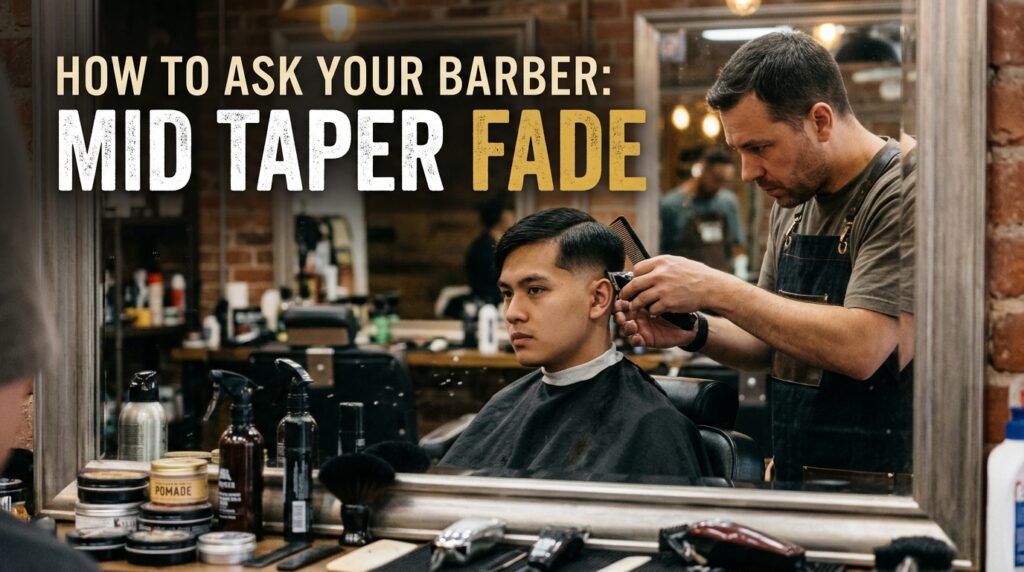
Clear words lead to a better cut. Barbers are skilled, but they cannot read minds. Here is a simple way to talk to yours.
Step 1: Show a photo. Bring two or three pictures. Point out what you like. It could be the fade height, the fringe length, or the texture.
Step 2: Use the right words. Say “mid taper” or “mid fade.” Say “textured fringe.” Mention the length in inches or by pointing to your eyebrows.
Step 3: Talk about your hair. Tell the barber if you have a cowlick, a thin spot, or curls. This helps them plan the cut.
Step 4: Share your routine. Say how much time you spend on your hair. If you only have three minutes, say so.
Here is a sample script you can use.
“I’d like a mid taper with a textured fringe. Keep the sides short but not down to the skin. Leave about three inches on top. I want the fringe to sit on my eyebrows and look soft, not heavy.”
A few extra questions are worth asking.
- What guard number are you using on the sides?
- Can you thin the top to remove bulk?
- Will you cut the fringe with scissors or a razor?
- What product do you suggest for my hair type?
Common words you may hear:
- Point cutting: Snipping into the ends to make them uneven.
- Thinning shears: Scissors that remove bulk.
- Blend: Smoothing the transition between lengths.
- Guard: The clipper attachment that sets the length.
Do not be afraid to speak up during the cut. If something feels off, say so early. A good barber will welcome it.
Three-Step Styling Routine
The best part of this cut is how fast you can style it. You do not need a long routine. Three steps will do.
Step 1: Prep the Hair
Start with clean, damp hair. Towel dry it so it is not dripping. If your hair is fine or straight, spray in a little sea salt spray or texture spray. This adds grip and volume.
If your hair is curly or wavy, use a light cream or curl gel instead. Work it through from root to tip.
Step 2: Dry and Shape
Blow dry your hair. Use medium heat. Brush the fringe forward first. Then lift the top with your fingers or a round brush.
Dry the sides last. Keep them flat so the taper stays crisp. If you have curls, you can use a diffuser or let them air dry.
Step 3: Add Product and Finish
Take a small amount of product. A dime-sized amount is enough. Rub it between your palms until it warms up. Then run it through your fringe, working from the back to the front.
Use your fingers to pull the ends apart. Do not over style. The goal is a soft, broken look. Finish with a light mist of hairspray if you need all-day hold.
Here is a quick guide to product choice.
| Product | Hold | Finish | Best For |
| Matte clay | Strong | No shine | Thick or straight hair |
| Paste | Medium | Low shine | Most hair types |
| Sea salt spray | Light | Natural | Fine or straight hair |
| Curl cream | Light | Soft | Wavy or curly hair |
| Pomade | Medium to strong | Shiny | Sleek, polished looks |
A few common mistakes to avoid:
- Using too much product. This makes hair look greasy and heavy.
- Applying products to dry, dirty hair. Start with clean hair.
- Brushing hair back when the cut is meant to fall forward.
- Skipping the blow dryer. Even a quick dry makes a big difference.
Straight vs Wavy vs Thick Hair
Your hair type changes how the cut looks and how you style it. Here is how to get the best result with each type.
Straight hair
Straight hair has less natural movement. A textured fringe adds what the hair lacks.
What works:
- Ask for layers and point cutting on the fringe.
- Keep the fringe at a medium length so it does not look flat.
- Use sea salt spray or texture powder for grip.
What to avoid:
- Blunt, straight-across cuts that look stiff.
- Heavy gel or oil that makes hair stick together.
Straight hair also shows cowlicks more. If you have one at the front, tell your barber. They can cut the fringe to work with it, not against it.
Wavy hair
Wavy hair is the easiest to style. It already has body and flow. Your goal is to keep the waves neat.
What works:
- A medium-length fringe of two to three inches.
- A mid taper to keep the sides from puffing out.
- A light cream or sea salt spray on damp hair.
What to avoid:
- Brushing waves when dry, which can cause frizz.
- Cutting too short, which removes the wave pattern.
Let your waves dry naturally when you can. A quick scrunch with your hands will boost the pattern.
Thick hair
Thick hair has plenty of volume. The trick is to control it. Without a good cut, thick hair can look bulky.
What works:
- Ask the barber to thin the top and fringe with shears.
- Pick a slim mid taper to keep the sides tight.
- Use a strong matte clay or paste to hold the shape.
What to avoid:
- Letting the fringe grow too long without shaping.
- Using light products that cannot hold heavy hair.
Thick hair also tends to need more frequent trims. If the sides start to look wide, book your next visit sooner. Every three to four weeks is a good rule.
Here is a quick summary of all three.
| Hair Type | Fringe Length | Best Product | Trim Schedule |
| Straight | Medium | Sea salt spray, paste | Every 4 to 5 weeks |
| Wavy | Medium to long | Light cream, sea salt spray | Every 4 to 6 weeks |
| Thick | Short to medium | Matte clay, strong paste | Every 3 to 4 weeks |
Frequently Asked Questions
What is a mid taper fade with a textured fringe?
It is a haircut with short, gradually blended sides and a longer, layered top that falls forward. The fringe has broken ends for a soft, natural look.
Is a mid taper or a mid fade better for a textured fringe?
A mid taper is softer and easier to keep. A mid fade is bolder and sharper. Pick the taper for a classic look and the fade for strong contrast.
How long should my hair be for a textured fringe?
Most men need about two to four inches on top. Short fringes work at one to two inches. Curly hair often needs a bit more length.
How often should I get a mid taper fade trimmed?
Most men trim every three to five weeks. A mid fade may need a visit every two to four weeks to stay sharp.
What product is best for a textured fringe?
Matte clay or paste works for most hair types. Use sea salt spray for fine hair and a light cream for waves or curls.
Final Thoughts
The mid taper fade with a textured fringe is a smart, flexible haircut. It gives you a clean base and a relaxed top. It works for straight, wavy, curly, and thick hair. It also fits many face shapes and many lifestyles. Whether you pick a soft taper or a bold fade, the core idea stays the same: neat sides and a soft, shaped fringe.
The best results come from a few simple steps. Know your hair type. Bring photos to your barber. Choose a fringe length that suits your face and your routine. Then keep your styling light and easy. With a good cut and the right product, you can walk out of the shop looking sharp and feel confident all year in 2026.

Adam Collins is a fashion writer and content researcher at Faxhion Serp. He focuses on fashion trends, clothing, styling ideas, accessories, and practical wardrobe guidance. Adam creates clear, well researched articles designed to help readers understand fashion topics, discover fresh ideas, and make informed style choices.